Author: brandonaubin
Article Summary
Previous studies have shown that rate of force development (RFD) has a significant relationship with sporting events requiring high-power output. During these dynamic explosive activities, there is a limited amount of time available to produce force, and therefore, the rate at which force is generated becomes very important. To develop force, a muscle must take up the slack within the tendon. Therefore, a tendon that is less stiff would result in an increased time in which to develop force. Rate of force development has been seen to increase after relatively short periods of training (6 weeks); this is thought to be caused by enhanced neural drive in the early phase of muscle contraction.
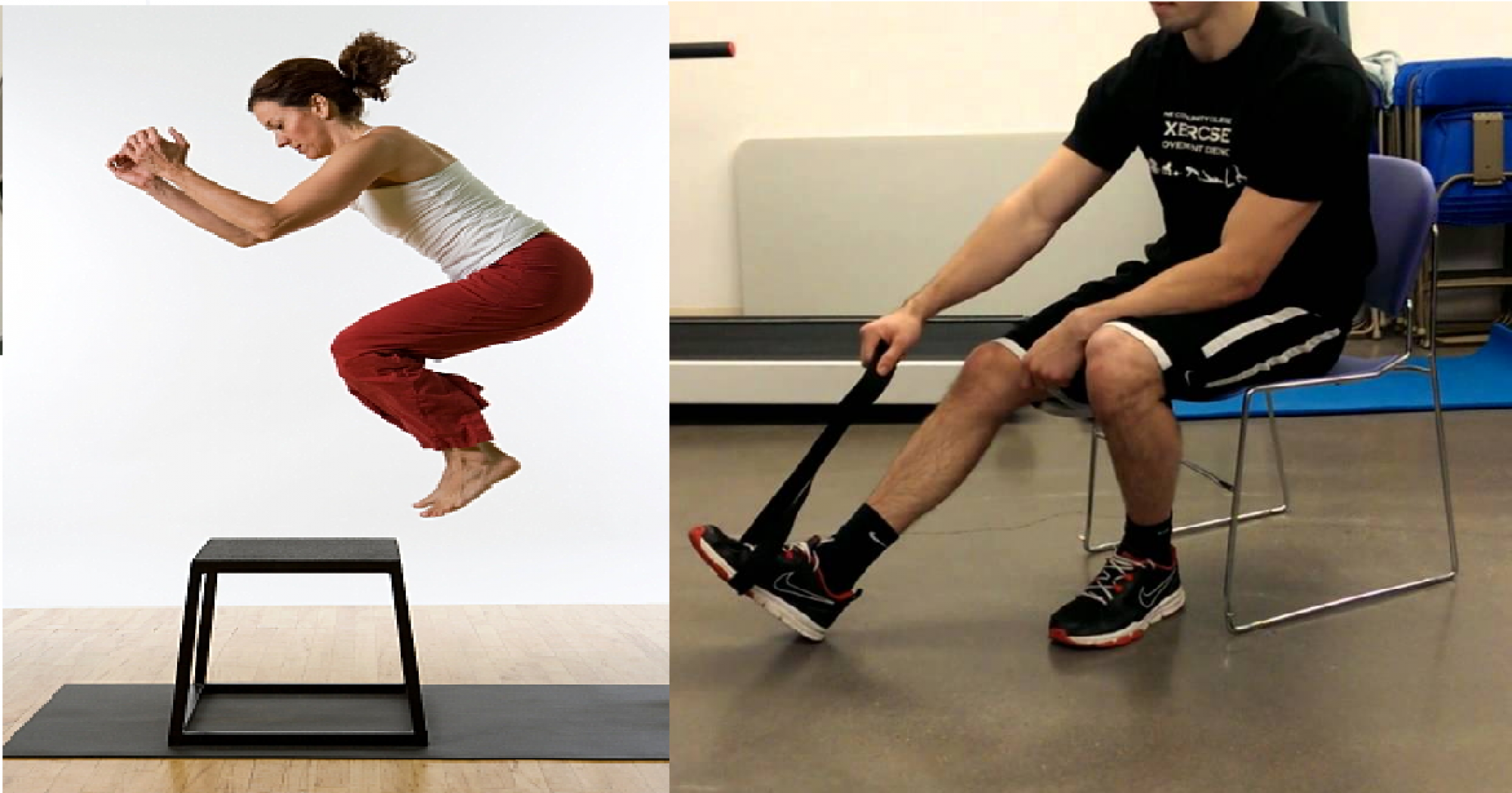
With this knowledge in mind, they started experimenting right way. The approach they took to this was to randomly allocate 1 of 2 groups and they were to train for a period of 6 weeks. 1 group trained isometrically and the other trained plyometrically. They are aiming to measure medial gastrocnemius tendon stiffness , jump height, and RFD. They had thirteen men, with a mean age of 23 + , a height of 179.8 + 5.2 cm, and a body mass of 76.8 + 6.1 kg, participated in the study and were assigned to either the plyometric or isometric training group. The isometric training consisted of repetitions of maximal one-legged explosive isometric plantar flexion, and the plyometric training consisted of repetitions of maximal one-legged straight-legged drop jump.
Before initial testing, each participant was familiarized with the testing protocol. Participants were tested before and after the 6-week training period on the following unilateral tests: a maximal straight-legged concentric jump; an explosive maximal isometric plantar flexion, and a graded isometric plantar flexion, used in the determination of tendon stiffness. In addition, they did a two-way ANOVA was used to identify main effects of group and pre- to post test changes for each of the variables measured.
To measure the elongation and stiffness of the tendon, they used a modified Smith machine. (UO82; Leisurelines, Leicestershire, UK) The participant stood on a portable force plate (Kistler type 9286A; Hampshire, UK), and the bar was locked at shoulder height so that when the participant stood on 1 straight leg they were effectively trapped between the bar and the force plate; this ensured that when plantar flexion occurred, the heel could not lift off the floor.
For the “Unilateral Straight Legged Concentric Jump and Explosive Isometric Test”, the participant stood on the portable force plate on 1 straight leg with his hands on his hips and jumped straight upward (no counter movement) by plantar flexing.
The results show that isometric and plyometric training both significantly increased medial gastrocnemiustendon stiffness . Furthermore, with training, no significant difference in relative changes of stiffness between the groups occurred.
To Conclude, isometric training (6 weeks) in a standing position has been shown to significantly increase tendon stiffness and RFD, showing similar increases to plyometric training. Isometric training, therefore, seems to improve not only isometric performance but also has a cross-over effect of improving concentric performance as evidenced by increased jump height. Plyometric training has been shown to place large stresses on the body, caused by large impact forces on landing, which can lead to a potential for injury and has also been reported to cause muscle soreness.
Reference:
Journal of Strength and Conditioning Research, 2007, 21(3), 986–989, 2007 National Strength & Conditioning Association
Reflection ( Why is this study important):
This study was really interesting and important to me because isometrics is a term and a form of exercise that the majority of the population are not aware of. It is not the populations fault for not being so aware of this amazing form of exercise because a lot of the fitness industries today focus more on the sarcoplasmic hypertrophy(size/ bodybuilding) for the public.( Not saying its all we see. Only that majority of the public are following this type of training) Isometrics have many great benefits on increasing maximal strength, density, sinew strength( tendons and ligaments),great neural connection from you nervous system to your muscles( mind to muscle link) and can be easily transfer to sports or other movement needed for power or strength. I’ve been using isometrics for almost a decade now and I can tell you from my own experience, it has dramatically improved the quality of my life in many ways. Due to the nature of the exercise, it is really difficult to injure yourself compare to weight training or plyometrics. Weight training require really heavy weights and plyometrics require high impact forces to develop the tendons and muscle density. On the hand, isometrics require no weights or high impact forces to develop the tendons. You can also see in the full article how dramatic the subjects strength has increased by using isometrics. I strongly suggest to anyone reading this article to start applying isometrics to your training program. Just keep an open mind and try it before judging it. It is and will be really beneficial! (Speaking from my own experience)
May your strength and power increase endlessly!
 PLYOMETRIC VS. ISOMETRIC TRAINING INFLUENCES ON TENDON PROPERTIES AND MUSCLE OUTPUT